

Quick Links
For more information on the history of the Jabez Howland House, read our new article: The Jabez Howland House: A Timeline

The Jabez Howland House

33 Sandwich Street
Plymouth, MA 02360
The Jabez Howland House is open for the season.
Our 2026 season begins June 12th and ends October 30th
Hours: 10:00 am - 4:00 pm | Thursday through Monday
$6.00 for adults
$5.00 for seniors, military members, students, or AAA members
$2.00 for children between the ages of 6 -12
FREE - children under 6, Plymouth residents, and Howland Society members
A Brief History of the House
The Jabez Howland House is the only currently standing building in Plymouth where Pilgrims spent time. The original 17th century, two-story timber framed house consisted of a porch, hall, and hall chamber. Jabez Howland, one of John and Elizabeth's sons, lived here with his family until they sold the house in 1680. It remained a private residence until 1912 when it was purchased by the Pilgrim John Howland Society to become a multigenerational museum. The Howland House is listed on the National Register of Historic Places.

Interpreter Wendy Pratt Bagley demonstrates 17th century artifacts and their uses.
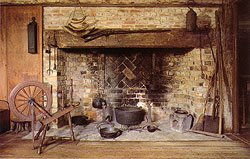
The Howland Society performed extensive work in the 1940s to bring the house back to its original appearance. Today, the museum contains a variety of period furniture and artifacts across several generations of the Early Colonial period. The Jabez House features multiple items from archaeological digs conducted at John and Elizabeth Howland's Rocky Nook home, as well as their son Joseph’s farm. Other objects of interest include letters and documents connected to the Howland family, such as those from descendant Franklin Delano Roosevelt and his "cousin", Winston Churchill (who is descended from John Howland's brother, Arthur), and much more.


Authentic 17th century scenes and artifacts in the Jabez Howland House

Gardens at the Howland House display European and Indigenous plants that were common in 17th century Plymouth.
The Society also maintains the historic sites at Rocky Nook. These were the locations of John and Elizebeth Howland's homestead and their son Joseph’s farms on Howland Lane in Kingston, Massachusetts. See Rocky Nook for more information.

As the Mayflower plowed westward through high seas in the fall of 1620 on its way to the New World, John Howland was suddenly swept overboard. As he fell, he grabbed a long line that dangled from the ship's rigging into the churning sea. The ship dragged Howland through the surf several fathoms deep. The ship's crew quickly hauled the soggy passenger back aboard with the aid of a boat hook.
This tale comes to us from the second governor of Plymouth Colony, William Bradford, who introduces us to John Howland, a “lustie yonge man” ("lustie" meaning "strong, able-bodied"). By the time of his death in 1672 at over 80 years old, John Howland was the last male Mayflower passenger living in Plymouth.
John Howland and his wife, Elizabeth Tilley, also a Mayflower passenger, had four sons and six daughters. Jabez, their eighth child and his wife Bethia lived in the house at 33 Sandwich Street in Plymouth. The house was built by Jacob Mitchell about 1667, sold to Jabez Howland in 1669, who lived there with his family until they moved to Bristol, Rhode Island in 1680.
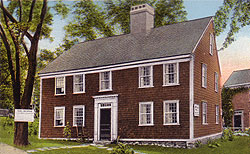
The older part of the Howland House was built about 1667. Tt appears that the height of the roof was raised to provide rooms on the second floor during Jabez’s ownership, matching the layout of those on the first. An addition was made in 1750 which added a second architectural period to the structure. Per a copy of the deed at the Plymouth County Registry of Deeds, Jabez Howland sold the house to Elkanah Watson on January 10, 1680. An excerpt from the deed reads as follows:
“Jabez Howland of Plymouth a “Blacksmith” in consideration of 50 lbs. Current silver money paid by Elkanah Watson a “Blacksmith” to him and his Heirs forever hath sold all the my house and land called by the Name of a garden spot. Be it one-half acre that I bought and purchased of Jacob Mitchell lying and being on the south side of the house and garden of Gyles Rickard senior with all other edifices, buildings and fences that have and are New Made and set upon said Garden spot and also all the my two acres of Upland that was given unto me by my father Mr. John Howland in his last will and lying and being on the west end of the aforesaid garden between the said Town Brook and the lands of said Gyles Rickard senior and exchanged unto me by aforesaid town of Plymouth lying and being between the aforesaid Town Brook and the said Gyles Rickard his land and adjoynes unto the aforesaid Uppland given me by will.”
Old Colony Records, Vol. 4, Page 393
Jabez’ signature was followed by two items:
“Elizabeth Howland senior yeieded up her free right also in the house and land above mentioned, Before mee William Bradford Assistant”.
“Bethyah Howland wife of Jabez Howland above mentioned gave her free consent to this deed the 15th of January 1680 before mee William Bradford Assistant”.
Old Colony Records, Vol. 4, Page 393
“Owned by Jabez Howland before the death of his father and mother, it is fair to presume that its floors have been trodden by those two passengers of the Mayflower, and that its walls have listened to their voices. Let this ancient structure be added to the list of Pilgrim Memorials, and hereafter share with the Rock our veneration and respect.”
William T. Davis, Ancient Landmarks of Plymouth, 1887
The house was occupied as a dwelling until 1912 when the Pilgrim John Howland Society purchased it. This was the result of the tireless efforts of Lillie Blanche Huckins Titus, one of the Society's founders and its Secretary-Treasurer at the time of the purchase.
In June of 1923, the Howland Society purchased and later demolished the decrepit old stable twenty feet south of the house, removing a fire hazard. The additional ground was landscaped, a flagpole was erected, and a driveway and parking area provided. Around 1933 and 1934, the Society purchased and removed the Miles House, a structure which adjoined the Jabez Howland House property.
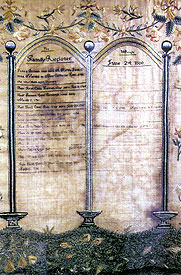
The Howland Society's annual meeting in 1936 drew up plans to restore the Jabez Howland House to the period of its erection. Brig. Gen. Charles R. Howland was appointed Chairman of the Restoration Committee. Sidney T. Strickland, AIA of Boston and Plymouth, was engaged to draw reconstruction plans. A fund for this purpose was started in 1937 and, on August 30th, 1941, the restored house was rededicated. Col. Francis R. Stoddard, a Howland member, and the Governor General of the General Society of Mayflower Descendants gave the address.
Since that time, the house has been maintained in good condition and the furnishings have been exchanged for more period-appropriate pieces. These furnishings have come from purchases with funds of the Howland Society and by gifts from its members and friends. As we see it today, it is a comfortable home by 17th century standards.


